18 Popular Cat Breeds in Kentucky: From Maine Coons to Sphynx Cats

October 9, 2026

Kentucky’s mix of horse-country farmland, growing cities like Louisville and Lexington, and cold, damp winters shapes which cats thrive in local homes. Popular cat breeds in Kentucky range from massive, shaggy-coated Maine Coons to sleek, hairless Sphynx cats that need a sweater on a January morning. Breeders across the state, from Bowling Green to the Bluegrass Parkway, report steady demand for both classic pedigreed cats and the humble household mixes that fill Kentucky’s shelters.
This rundown covers 18 breeds commonly found in Kentucky homes, catteries, and rescues, along with the traits that make each one a good (or tricky) fit for a Kentucky household. Whether someone wants a low-maintenance lap cat for a Louisville apartment or a cold-hardy companion for a farmhouse near the Cumberland Plateau, there’s a breed profile here worth knowing before bringing a new cat home.
Pro Tip: Long-haired breeds like Maine Coons, Persians, and Himalayans need brushing at least two to three times a week during Kentucky’s humid summers to prevent mats and reduce shedding indoors.
1. Maine Coon

The Maine Coon (Felis catus) is one of the largest domesticated cat breeds, known for tufted ears, a bushy tail, and a shaggy, water-resistant coat built for cold weather. According to the Cat Fanciers’ Association, ever since a Maine Coon Cat took first place at the first U.S. cat show in 1895, these “gentle giants” of the cat world have been captivating feline fanciers everywhere. The breed has held its position at the very top of the rankings recently, and it’s no wonder that they’ve achieved the top ranking for the second year in a row, according to CFA’s 2026 data. Intelligent, adaptable, and sociable, their characteristic shaggy coats and imposing size never fail to attract attention, and they are playful, easy to train, and very loyal to their owners. That cold-weather coat makes the Maine Coon one of the better cat breeds for cold climates, a real asset during a Kentucky ice storm. Fittingly, the breed’s home state has its own well-documented pet culture, including the popular dog breeds in Maine that share the same rugged New England roots.
2. Bengal

Bengals stand out with a wild, leopard-like spotted or marbled coat inherited from ancestors crossed with the Asian leopard cat. They are high-energy, vocal, and love climbing cat trees, running an agility course, or chasing a laser pointer until they’re worn out. In Kentucky, The Kitten Finder notes that Bowling Green – Breeders here often specialize in Bengals and Siamese, reflecting steady regional demand for the breed. Bengals need daily interactive play and enough vertical space to climb, so a small apartment without enrichment is rarely a good match. Owners drawn to a Bengal’s athletic build often compare notes with cat lovers in warmer, more populous states, and the trend lines in the popular cat breeds in Texas guide show a similar appetite for bold, exotic-looking cats.
3. Bombay

The Bombay was developed by crossing a sable Burmese with a black American Shorthair to create a compact cat that resembles a miniature black panther, right down to its copper or gold eyes. Bombays are affectionate, people-oriented, and tend to follow their owners from room to room rather than hiding when guests arrive. Their short, sleek coat needs minimal grooming, which makes the breed a practical choice for a busy Kentucky household that wants a striking cat without a heavy brushing routine. Because the Bombay was bred specifically for temperament as much as looks, most individuals settle in quickly with children, dogs, and other cats. That easygoing nature is part of why compact, single-coated breeds keep showing up on regional favorites lists, echoing patterns seen among the popular cat breeds in Japan, where calm, low-shedding cats are prized in smaller living spaces.
4. British Shorthair

The British Shorthair is instantly recognizable for its round face, copper or gold eyes, and dense, plush coat, most famously in “British Blue” gray. According to Rover, an old and cherished breed from the United Kingdom, the British Shorthair is a sturdy, medium-large cat known for its plush, dense coat and famously round face. This breed tends to be calm, independent, and unbothered by change, which suits owners who work long hours and want a cat that doesn’t demand constant attention. Its thick coat also helps it handle Kentucky’s colder months better than thin-coated breeds. Fanciers researching regional trends often find the same calm, sturdy body type favored among the popular cat breeds in New York, where apartment living rewards a low-key temperament.
5. Exotic Shorthair

Often called “the lazy man’s Persian,” the Exotic Shorthair has the same flat face, round eyes, and stocky body as a Persian but with a short, plush coat that needs far less grooming. The breed currently sits among CFA’s top pedigreed cats, and the Cat Fanciers’ Association’s 2026 rankings place the Exotic at number four nationally. Exotic Shorthairs are quiet, gentle, and content to nap for most of the day, making them a good fit for a Kentucky family that wants a Persian-style lap cat without daily brushing sessions. A Kentucky cattery, DjaVuPurrs, is noted by KittySites for dedicated breeding healthy and quality Persian and Exotic Shorthair of Golden and Bi-color lines, showing the breed has an established regional presence.
6. Highland Lynx

The Highland Lynx is a hybrid breed developed from the Jungle Curl and Desert Lynx lines, prized for its curled ears, bobbed or short tail, and occasional polydactyl (extra-toed) paws. It has a wild, lynx-like appearance but a domestic temperament, often described as dog-like in its loyalty and willingness to play fetch. Kentucky listings on PetzLover confirm the breed circulates among diverse breeds like Bengal, Bombay, British Shorthair, Calico, Exotic Shorthair, Highland Lynx, Himalayan and others available across the state. Because Highland Lynx cats are still a relatively new and uncommon hybrid, prospective owners should confirm health testing and lineage documentation with any breeder rather than assuming standardized breed norms apply. Regional interest in unusual, wild-looking hybrids also shows up in warmer growth markets, including the popular cat breeds in Arizona guide.
Common Mistake: Assuming hybrid or wild-looking breeds like the Highland Lynx or Savannah are low-key apartment pets. Most need daily enrichment, climbing structures, and supervised outdoor time or a secure catio to stay mentally healthy.
7. Himalayan

The Himalayan is essentially a Persian in Siamese coloring, the result of crossing the two breeds to produce a long-haired cat with a flat face and striking blue, color-point eyes. CFA classifies the Himalayan as a division of the Persian breed rather than a fully separate one, but many Kentucky breeders and shelters still list it individually, as seen in Adopt-a-Pet’s Kentucky listings. Himalayans are quiet, gentle, and best suited to indoor life, since their thick double coat traps mats easily and their flat face makes outdoor heat tolerance poor. That same dense coat is one reason the breed appears on lists of cold-weather cat breeds; it holds warmth well during a damp Kentucky winter. Owners who want an indoor-only, low-activity companion often compare notes with the popular cat breeds in Canada, where cold-climate coats are a bigger factor in breed choice.
8. Manx

The Manx originated on the Isle of Man and is best known for its naturally short or entirely absent tail, caused by a genetic mutation affecting the spine. Despite the unusual trait, Manx cats are muscular, playful, and known for a rounded, rabbit-like hop when they run. Kentucky shelters regularly list the breed, with Adopt-a-Pet including Manx among the breeds available for adoption statewide.
Because the tailless gene can occasionally affect spinal development, reputable breeders screen carefully and avoid breeding two completely tailless cats together. Families searching for an active, dog-like companion cat sometimes look at regional guides such as the popular dog breeds in Missouri for comparison, since Manx cats are frequently described as having a canine-like devotion to their people.
9. Persian

The Persian is one of the oldest and most recognizable breeds, defined by its flat face, long flowing coat, and calm, dignified temperament. It remains near the top of national rankings; the CFA’s 2026 top 10 places Persian at third overall. In Kentucky specifically, The Kitten Finder reports that Lexington – A popular area for Persian and Ragdoll kittens, often home-raised.
Persians need daily face cleaning and near-daily brushing to prevent their coat from matting, plus regular eye care since their flat face structure makes tear staining common. They do best as strictly indoor cats, which also makes them one of the more practical indoor cat breeds for cold Kentucky winters when outdoor time isn’t appealing anyway.
10. Savannah

The Savannah is a hybrid between a domestic cat and the African serval, resulting in a tall, long-legged, spotted cat that can weigh considerably more than an average house cat. Savannahs are athletic, curious, and often described as needing a leash, a large cat tree, or secure outdoor access to burn off energy. Kentucky breeders acknowledge the demands of the breed directly; one listed on KittySites is dedicated to helping buyers learn the truth about the Savannah Cat before committing.
Depending on the generation (F1 through later generations), Savannahs carry varying amounts of serval ancestry, which affects both size and legal ownership rules in some states, so Kentucky buyers should confirm local regulations before adopting. Interest in large, athletic hybrids also tracks with trends noted in the popular cat breeds in California roundup.
11. Scottish Fold

The Scottish Fold’s signature folded ears come from a natural genetic mutation first noticed in a Scottish barn cat in the 1960s, giving the breed its round, owl-like face. Scottish Folds are generally quiet, adaptable, and known for sitting in unusual “Buddha-like” poses. PetzLover’s Kentucky listings confirm the breed is actively available in the state alongside other in-demand types like Savannah, Scottish Fold, Siamese.
Important Note: The same mutation that folds the ears can affect cartilage elsewhere in the body, sometimes leading to joint stiffness or early arthritis. Responsible breeders screen breeding pairs carefully and avoid pairing two folded-ear cats together to reduce this risk. The breed’s distinctive look has fueled global popularity, including strong demand documented in the popular cat breeds in Japan guide, where the Scottish Fold has become something of a cultural icon.
12. Siamese

Few breeds are as instantly recognizable as the Siamese, with its slim body, wedge-shaped head, and vivid blue, almond-shaped eyes set against a color-point coat. Siamese cats are famously vocal and social, often described as needing near-constant conversation and company rather than long stretches of alone time.
In Kentucky, The Kitten Finder notes the breed is a Bowling Green specialty, and HappyPawsUS lists Siamese, Russian Blue, Burmese, Exotic Shorthair, and Devon Rex among the state’s most requested purebred kittens. Because the breed bonds so tightly with its people, a Siamese left alone for long workdays without a companion animal may become anxious or destructive. Owners comparing regional demand for talkative, people-focused cats often reference the popular cat breeds in Georgia guide, which shows similar patterns across the broader South.
13. Snowshoe
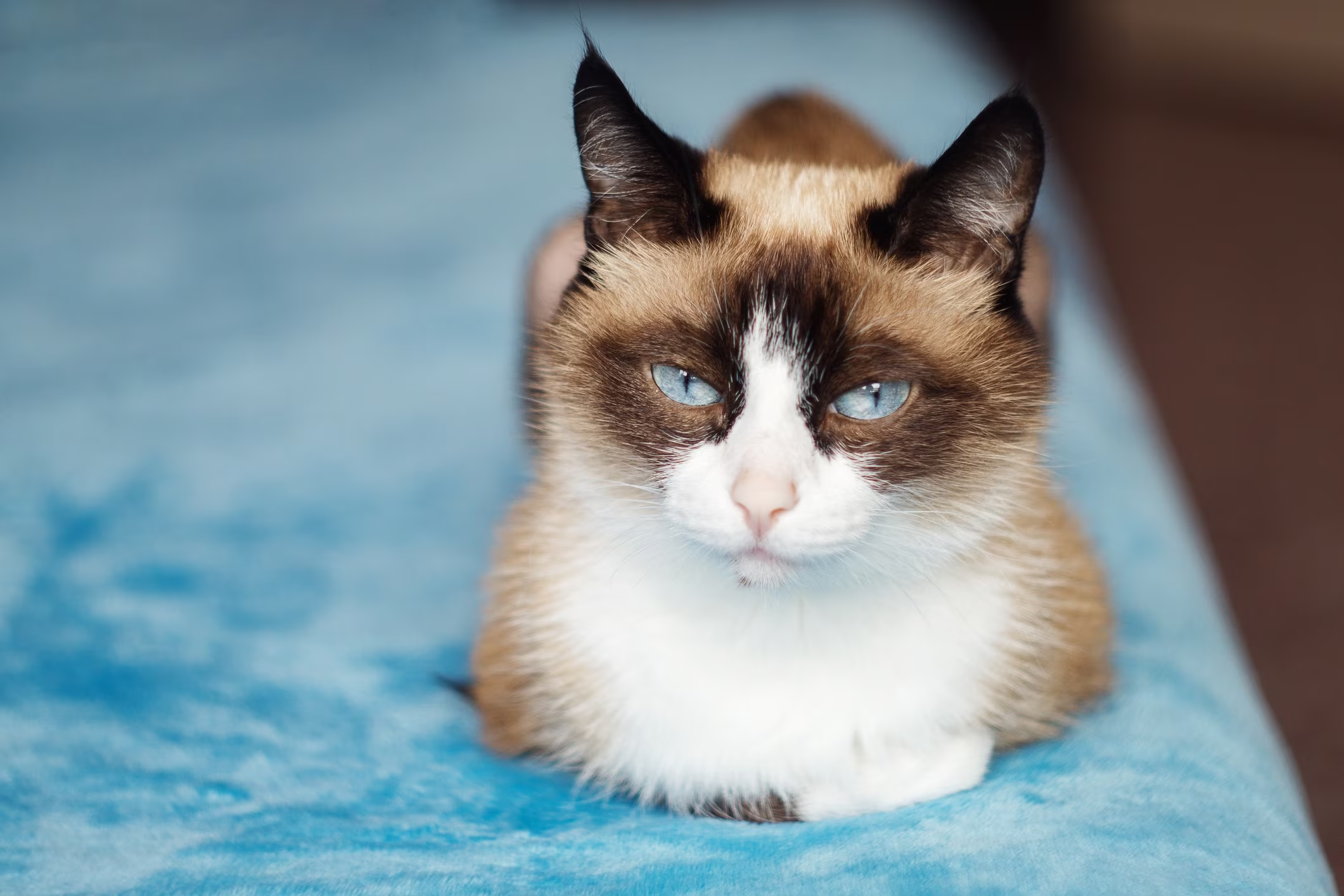
The Snowshoe combines Siamese color points with white “boots” on its paws, a look that came from an early cross between Siamese and American Shorthair lines developed in Philadelphia in the 1960s. Snowshoes tend to be affectionate, moderately vocal, and less demanding than a pure Siamese, making them a good middle-ground choice.
Kentucky’s own breeding community has experimented with the look; KittySites lists a Kentucky cattery running a Snowshoe program starting summer 2019 alongside its Siamese and Balinese lines. Because the white-boot pattern is genetically tricky to produce consistently, kittens from the same litter can look quite different from one another, and finding a Snowshoe with textbook markings sometimes takes patience and a waitlist.
14. Sphynx

The Sphynx is best known for its lack of fur, the result of a natural genetic mutation first bred selectively in Toronto in the 1960s. Without a protective coat, Sphynx cats need sunscreen or shade outdoors, sweaters in cold rooms, and regular bathing to remove the skin oils a normal coat would otherwise absorb. Because Toronto is where the modern breed took shape, its cold-climate origin story pairs naturally with the popular cat breeds in Canada guide.
Important Note: Sphynx cats are sometimes marketed as hypoallergenic because they lack a shedding coat, but the allergens most people react to come from a cat’s saliva and skin, not just fur. A Sphynx can still trigger allergies, though some owners find symptoms milder than with heavily shedding breeds. Sphynx cats are highly social, often described as more dog-like than cat-like, and do best as strictly indoor pets since they have no fur to regulate body temperature outdoors.
15. Ragdoll

The Ragdoll is a large, docile breed known for going limp when picked up, a trait that Catster confirms is even known for going limp when being picked up, which is where they got their name. The breed ranks near the very top of national popularity, sitting at number two on the CFA’s 2026 rankings.
Ragdolls are relaxed, affectionate, and generally patient with children and other pets, which makes them a common request among Kentucky families. Catster notes that despite strong demand, while a popular breed for both pets and shows, you’ll find only a handful of ethical breeders in Kentucky, so buyers should expect waitlists and plan ahead. Their semi-long coat sheds less than a Persian’s but still benefits from weekly brushing to stay tangle-free.
16. Domestic Short Hair

The domestic short hair isn’t a formal pedigreed breed at all, but a broad category covering the common house cat, Felis catus, in nearly every color and pattern imaginable. According to Mounds Pet Food Warehouse, the Domestic Shorthair, not to be confused with the American Shorthair, can exhibit a wide variety of physical features, and is considered the “mutt” of cat breeds, typically growing to medium size with short coats and round faces.
Pro Tip: Domestic short hairs make up the majority of cats in Kentucky shelters, and adopting one often costs a fraction of a pedigreed kitten’s price while still delivering a healthy, well-socialized companion. Adopt-a-Pet’s Kentucky search tool lists Domestic Shorthair as one of the most searched categories statewide, reflecting just how common this genetically diverse group is in everyday Kentucky households. For a broader look at how these mixed-breed cats stack up against pedigreed favorites nationally, the most popular cat breeds guide offers useful context.
17. Domestic Long Hair
The domestic long hair is the long-coated counterpart to the domestic short hair, a mixed-breed cat with no single standardized look but typically a coat that requires more grooming than its short-haired cousin. These cats can carry genes from Maine Coons, Persians, Ragdolls, or any number of long-haired ancestors without belonging to any recognized breed.
Adopt-a-Pet’s Kentucky listings include Domestic Longhair as a standard search category, showing the group is common enough in Kentucky shelters to warrant its own filter. Because coat length and density vary so much within this group, new owners should ask a shelter or rescue about grooming needs before adoption rather than assuming every long-haired mix needs daily brushing. Some domestic long hairs shed minimally, while others mat quickly without regular care, especially during Kentucky’s humid summer months.
18. Burmese

The Burmese is a compact, muscular cat with a rounded head, golden eyes, and a satin-like coat that originally came from Southeast Asia before being refined in the United States. The breed is famously people-oriented, often following owners around the house and vocalizing to stay part of the conversation.
HappyPawsUS lists the Burmese among Kentucky’s most requested purebred kittens, alongside Siamese, Russian Blue, Burmese, Exotic Shorthair, and Devon Rex. Burmese cats have a single, short coat that needs minimal grooming, making them a practical choice for owners who want a highly social cat without a heavy maintenance routine. Their Southeast Asian roots and continued global popularity connect to broader patterns covered in the popular cat breeds in Hong Kong guide.
Choosing among these popular cat breeds in Kentucky comes down to matching a cat’s coat, energy level, and personality to the realities of a specific household, whether that’s a Louisville high-rise, a Lexington horse farm, or a rural property near the Cumberland Plateau.
Cold, humid winters favor thicker-coated breeds like the Maine Coon, Persian, and Himalayan, while strictly indoor cats like the Sphynx and Exotic Shorthair suit apartment life just as well. Kentucky’s mix of established catteries, specialty breeders, and well-stocked shelters means most of these 18 breeds are within reach for a patient, informed buyer or adopter.