20 Popular Cat Breeds in Nevada: From Desert Shorthairs to Cold-Climate Companions

October 30, 2026

Nevada asks more of a house cat than almost any other state. A cat in Las Vegas might face triple-digit summer afternoons, while a cat two hundred miles north in Reno or Carson City can wake up to snow on the ground. That split personality shapes which cat breeds Nevada households actually choose to live with, and it explains why some of the state’s favorites are built for heat while others carry coats thick enough for the Sierra foothills.
This guide walks through the 20 popular cat breeds that show up most often in Nevada homes, shelters, and catteries, from unregistered shorthairs to pedigreed favorites like the Maine Coon and Ragdoll. Nevada also ranks among the states with the highest per-capita search interest in pet breeds generally; MetLife Pet Insurance found that “Texas, Nevada, and California have the highest search volume for dog breeds per capita”, a pattern that tracks closely with how curious Nevada cat owners are about breed research too.
| Breed | Coat Type | Heat Tolerance | Cold Tolerance |
|---|---|---|---|
| Domestic Shorthair | Short | High | Moderate |
| Domestic Mediumhair | Medium | Moderate | Moderate |
| Domestic Longhair | Long | Low | High |
| Siamese | Short | High | Low |
| Maine Coon | Long/shaggy | Low | Very High |
| Russian Blue | Dense double | Moderate | High |
| Bengal | Short | High | Moderate |
| Ragdoll | Medium-long | Low | Moderate |
| Snowshoe | Short | High | Moderate |
| Bombay | Short | Low | Moderate |
| Himalayan | Long | Low | High |
| Manx | Short/medium | High | Moderate |
| Sphynx | Hairless | Very Low | Very Low |
| Persian | Long | Low | High |
| Norwegian Forest Cat | Long, water-resistant | Low | Very High |
| American Shorthair | Short | High | Moderate |
| Abyssinian | Short | High | Moderate |
| Burmese | Short | High | Low |
| Egyptian Mau | Short | High | Low |
| Calico (pattern) | Varies | Varies | Varies |
Pro Tip: Whatever breed you choose, keep water bowls filled and consider a pet fountain during Nevada’s summer months. Cats drink more readily from moving water, and staying hydrated is one of the simplest ways to prevent heat stress.
1. Domestic Shorthair

The domestic shorthair is not a pedigreed breed in the traditional sense; it is the catch-all term for the short-coated Felis catus that makes up most of the world’s pet cat population, including the majority of cats in Nevada shelters. Its short, low-maintenance coat sheds heat efficiently, which makes it naturally suited to Las Vegas summers. A popular cat breed list almost always puts the domestic shorthair near the top simply because it is everywhere.
Southern Nevada’s climate is genuinely tough on pets. TwoByTwo Pet Support notes that the desert’s extreme heat, intense UV exposure, dry climate, blowing dust, and wildlife create conditions that affect dogs and cats differently. Domestic shorthairs handle those conditions better than most, provided they stay indoors during peak afternoon hours.
2. Domestic Mediumhair
Domestic mediumhairs sit between short and long coats, giving them a bit more insulation without the grooming demands of a true longhair breed. This makes them a comfortable middle-ground choice for Nevada owners who split time between Las Vegas heat and higher-elevation towns like Pahrump or Boulder City. Shelters across the state, including those near Arizona’s border communities, frequently list mediumhairs among their most available adoptable cats.
Because they carry more undercoat than shorthairs, mediumhairs benefit from weekly brushing during shedding season, which peaks in spring and fall. Regular brushing also reduces the amount of loose fur floating around during Nevada’s dusty, dry months.
3. Domestic Longhair

The domestic longhair carries a full, flowing coat and, like its shorter-coated cousins, is defined by coat length rather than pedigree. According to PetCurious’s shelter listings for the Silver Springs area, the domestic longhair’s luxurious, flowing coat requires regular grooming to prevent matting, and these cats come in a wide range of colors and patterns. That grooming commitment matters more in Nevada than in cooler states, since matted fur traps heat against the skin.
Longhairs generally fare better in the state’s cooler pockets. Owners in northern Nevada, where winters resemble those described in guides to cat breeds in warmer states only by contrast, often find that a longhair’s coat is an asset rather than a liability once temperatures drop.
4. Siamese

The Siamese is one of the oldest recognized breeds, and its striking blue eyes and slender frame make it instantly identifiable. The Siamese cat originated in Thailand and is the first distinctively recognized breed of Oriental cat, with a very distinctive appearance featuring piercing baby blue eyes and large ears. Its coat carries what breeders call point coloration, meaning a pale body with darker color concentrated on the ears, face, paws, and tail.
Siamese cats are very outgoing and can be quite chatty, and they need a large amount of attention and companionship. That vocal, social nature made them a household name; Siamese cats quickly became one of the most popular cat breeds in Europe and North America during the 20th century. Nevada breeders serving Fernley, Sparks, and the Reno area, according to a Siamese breeder directory for Nevada, remain active today. Cat lovers curious how the breed’s popularity translates internationally can compare notes with our guide to popular cat breeds in Hong Kong, where Siamese-type cats also carry deep cultural roots.
5. Maine Coon

The Maine Coon is the rare breed that seems built for the opposite of Nevada’s climate, yet it remains a favorite among northern Nevada households near Lake Tahoe. A Maine Coon took first place at the first U.S. cat show in 1895, and these “gentle giants” of the cat world have been captivating feline fanciers ever since. Its shaggy, water-resistant coat and tufted paws were shaped by real New England winters, which is also why the breed shares its name with the state of Maine.
That same coat becomes a liability in Las Vegas. Charing Cross Cat Clinic’s Nevada rescue network points out that Nevada’s hot desert climate poses unique challenges for long-haired breeds like Maine Coons, though with proper indoor air conditioning and hydration they can thrive in the state’s dry climate. Owners in Reno, Carson City, and the higher-elevation counties have an easier time letting a Maine Coon’s natural coat do its job.
6. Russian Blue

The Russian Blue is prized for its short, plush double coat and calm, intelligent temperament. According to the Cat Fanciers’ Association, a Russian Blue’s luxuriously dense coat needs only minimal grooming while its emerald-green eyes radiate intelligence and affection. The dense coat traps less dander than many breeds, which is why Russian Blues are frequently mentioned in conversations about lower-allergen cats.
Important Note: No cat breed is truly hypoallergenic. Cat allergies are triggered mainly by the Fel d1 protein in saliva and skin oil, not fur length, so even low-shedding breeds like the Russian Blue can still trigger reactions in sensitive people.
The breed’s dense double coat also holds up well during northern Nevada winters, a trait shared with cats popular in colder states like those covered in our guide to cat breeds in New York.
7. Bengal

The Bengal’s short, dense coat and wild-cat-inspired spotted or marbled pattern make it one of the most visually striking breeds in any Nevada cattery. Because their coat is short and lacks a heavy undercoat, Bengals tolerate desert heat far better than longhaired breeds, though they still need indoor access to air conditioning during peak summer months. Their high energy levels also mean they do best with owners who can commit to daily play sessions.
Nevada’s neighboring desert-state pet owners in Arizona report similar enthusiasm for the breed, likely because Bengals adapt well to warm, arid climates that would stress a heavier-coated cat. Vertical cat trees and window perches give Bengals an outlet for their climbing instincts without exposing them to outdoor heat.
8. Ragdoll

The Ragdoll has topped national popularity rankings for years running, and Nevada households are no exception. The Cat Fanciers’ Association’s top 10 list for 2026, based on 2025 registrations, ranks the Maine Coon first and the Ragdoll second, while Catster’s tally of registration data found that the Ragdoll takes first place again, making it the fifth year the breed has remained at the top spot among their measured registrations. The Ragdoll’s vivid, oval-shaped blue eyes are one of its most distinctive features, and the breed has medium-long, silken coats flowing over sturdy, muscular bodies.
Ragdolls are famously docile and go limp when picked up, a trait that makes them easy to handle during vet visits or grooming sessions. Their laid-back temperament also suits apartment living, which is common in Las Vegas and Reno’s growing rental markets. Breeders serving the region, similar to those profiled in our popular cat breeds in Georgia guide, often report long waitlists for Ragdoll kittens.
9. Snowshoe
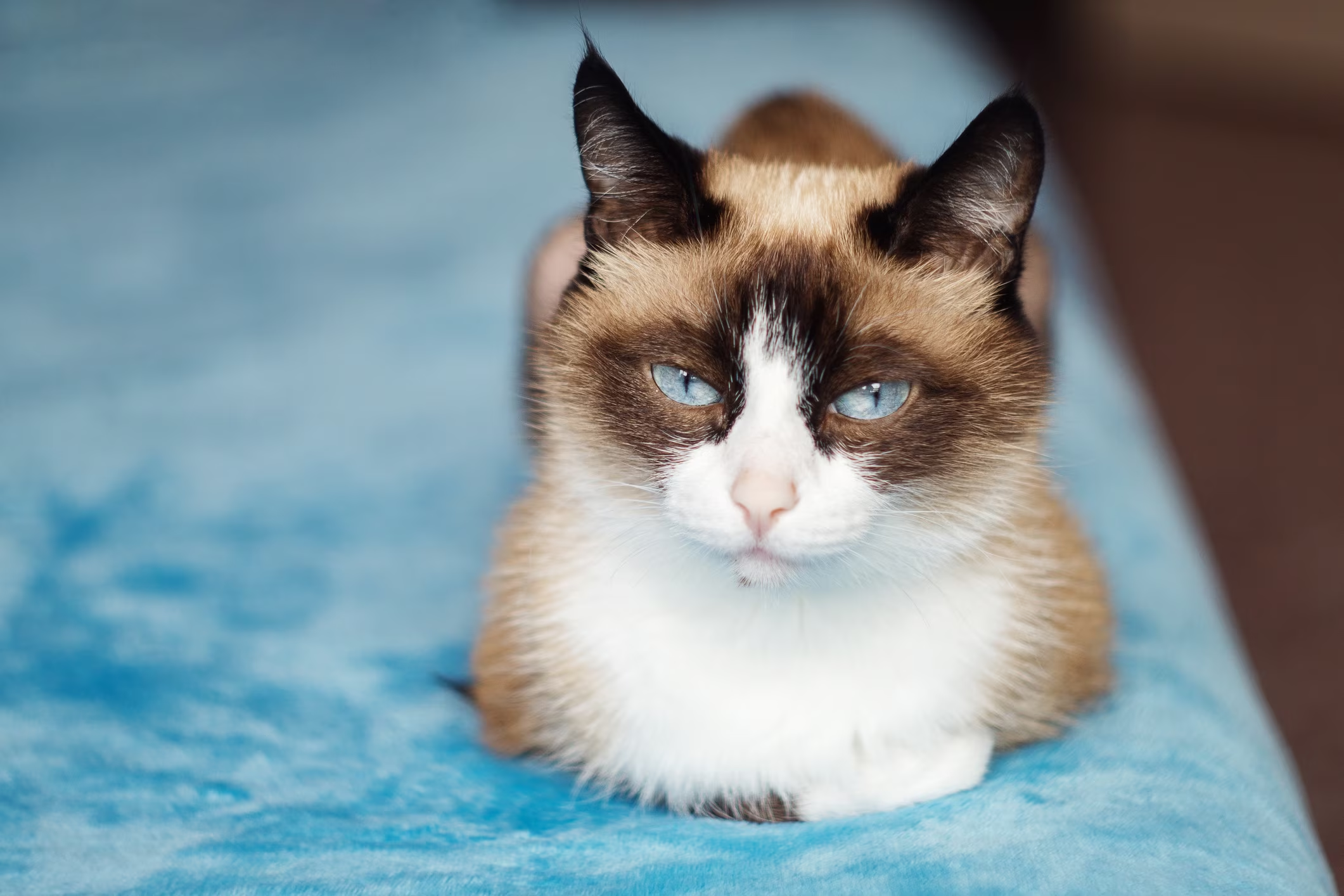
The Snowshoe gets its name from the white “boots” on its paws, a trait paired with a Siamese-style body and blue almond-shaped eyes. Despite the wintry name, the Snowshoe is an American breed developed from Siamese and American Shorthair stock, and it carries no special cold-weather requirements beyond what any short-coated cat needs. Its short coat actually makes it one of the more heat-tolerant point-coated breeds available in Nevada.
Snowshoes are relatively rare, and finding a reputable breeder often means looking beyond state lines. For comparison, colder-climate countries such as those featured in our guide to popular cat breeds in Canada tend to favor genuinely cold-hardy breeds like the Maine Coon or Norwegian Forest Cat over the Snowshoe, whose name is more aesthetic than functional.
10. Bombay

The Bombay is a sleek, all-black breed developed to resemble a miniature panther, with a short coat and copper or gold eyes. That solid black coat, while striking, absorbs more heat than lighter-colored fur. Pet Crates Direct’s guide to black cat care in Nevada explains that black cats absorb more heat due to their dark fur, so cooling mats, shaded areas, and air conditioning become essential strategies for keeping them comfortable.
Bombays are affectionate, people-oriented cats that tend to follow their owners from room to room, which makes it easier to notice if they seem overheated. Keeping a Bombay’s environment cool during the hottest stretch of a Las Vegas summer, typically June through September, protects a breed that already runs warm just by virtue of its coloring.
11. Himalayan

The Himalayan blends the Persian’s long coat and stocky build with the Siamese’s blue eyes and point coloration, creating one of the more visually dramatic breeds in this list. Its dense, long fur mats easily and needs daily combing to stay tangle-free, a grooming schedule that becomes even more important in Nevada’s dry, dusty air. Flat-faced breeds like the Himalayan also breathe less efficiently in extreme heat, so indoor cooling is not optional for this one.
Owners drawn to the Himalayan’s exotic look sometimes explore how flat-faced breeds are received elsewhere; our popular cat breeds in Japan guide covers a market with similarly strong appetite for striking, distinctive-looking cats.
12. Manx

The Manx is best known for its naturally short or entirely absent tail, a trait caused by a genetic mutation first documented on the Isle of Man. Beyond the tail, Manx cats have a rounded body, short-to-medium coat, and a playful, dog-like loyalty that surprises many first-time owners. Nevada cattery directories list active Manx breeders alongside Bengal and Munchkin lines, suggesting steady if modest demand for the breed statewide.
Because the Manx’s coat is relatively short, it handles desert heat reasonably well, though the breed’s stocky build means it can overheat faster than a leaner cat during outdoor exposure. For readers comparing breed popularity trends more broadly, our roundup of the most popular dog breeds in the United States shows how national rankings shift year to year in ways that mirror cat breed trends.
13. Sphynx

The Sphynx is the breed most people picture when they think of a hairless cat, though it actually has a fine layer of downy fuzz rather than true bare skin. Without a protective coat, Sphynx cats lose body heat quickly and sunburn easily, making them one of the least suited breeds to any direct outdoor exposure in Nevada. They also need sunscreen formulated for pets if they spend time near sunny windows.
Common Mistake: Assuming a hairless cat needs less climate management than a furry one. Sphynx cats actually require more temperature control, not less, since they have no coat to buffer either heat or cold.
A Las Vegas veterinary practice that treats heat-related cases each summer notes that heat is a serious hazard for cats because they can’t cool themselves off by sweating, and panting isn’t very effective for them, according to Aloha Animal Hospital. That warning applies with extra force to a Sphynx, whose lack of fur removes one of a cat’s few natural insulating layers.
14. Persian

The Persian is instantly recognizable for its flat face, round eyes, and dense, floor-length coat. Persian cats rank among the CFA’s top pedigreed breeds, known for their unique face and sweet disposition, as well as a luxuriously long coat that requires a lot of grooming to keep healthy. That grooming demand is non-negotiable in Nevada, where dry air and dust accelerate matting if brushing lapses even for a few days.
Persians are calm, low-energy cats that adapt well to indoor apartment life, which suits Nevada’s urban centers. Owners relocating from coastal states sometimes compare notes with our popular cat breeds in California guide, since Persians rank highly in both states despite very different climates.
15. Norwegian Forest Cat

The Norwegian Forest Cat carries a thick, water-resistant double coat built for Scandinavian winters, making it one of the most cold-adapted breeds on this list. It has become especially popular in cooler, wetter parts of the country; per MetLife’s regional search data, Norwegian Forest Cats command the Northwest in terms of search interest, a region whose climate more closely resembles the breed’s native environment than Nevada’s desert basin does.
In Nevada, the breed does best in the cooler, higher-elevation communities around Lake Tahoe and the Sierra foothills, where winter temperatures give that heavy coat a real job to do. Catster’s ranking of the year’s most popular breeds notes that classic longhaired breeds like this one continue to hold steady appeal even as newer breeds gain ground, according to Catster’s most popular cat breeds list.
16. American Shorthair

The American Shorthair is a working breed at heart, descended from cats brought to North America to control rodent populations aboard ships and later on farms. Its short, dense coat and muscular build make it easy-care and heat-tolerant, two qualities that suit Nevada’s climate well. The breed’s even temperament also makes it a solid choice for first-time cat owners statewide.
Unlike breeds adapted to humid climates, the American Shorthair’s coat sheds water and dirt easily rather than trapping moisture, which matters in Nevada’s dry, dusty conditions. That adaptability contrasts with breeds suited to more humid environments, similar to differences explored in our popular dog breeds in Hawaii guide, where humidity-tolerant coats matter more than heat-shedding ones.
17. Abyssinian

The Abyssinian has a fine, ticked coat where each hair carries several bands of color, giving the breed a warm, shimmering appearance. It is one of the most active and curious cat breeds available, often described as dog-like in its willingness to fetch and explore. That short coat and lean, muscular build make the Abyssinian naturally well-suited to warm climates like southern Nevada’s.
Because Abyssinians are so active, they need vertical space and enrichment to stay content indoors, which is essential during Nevada’s hottest months when outdoor access simply is not safe. A cat wheel or tall cat tree can help burn off energy that this breed would otherwise spend patrolling a yard in cooler climates.
18. Burmese

The Burmese has a short, satin-like coat and a compact, muscular body that belies its surprising weight when picked up, a trait longtime owners describe as “brick wrapped in silk.” Originally developed from cats brought from Burma, now Myanmar, the breed carries a warm, affectionate temperament and forms close bonds with its owners. Its short coat sheds heat efficiently, making it a comfortable fit for Nevada’s dry summers.
Burmese cats are vocal, though less insistently so than Siamese, and they tend to seek out warm laps and sunny windowsills year-round. That sun-seeking habit means owners should watch for overheating on especially hot days, even though the breed generally tolerates warm weather well.
19. Egyptian Mau

The Egyptian Mau is one of the few naturally spotted cat breeds, with a coat pattern that occurs organically rather than through selective breeding for a wildcat look. Its short, fine coat and lean, athletic body make it well-suited to hot climates, echoing the breed’s origins in a hot, arid region. Egyptian Maus are also notably fast, reaching speeds that rival some of the quickest domestic cat breeds.
Because the breed is still relatively rare in the United States, Nevada owners often need to work with out-of-state breeders or specialty catteries to find one. Their heat tolerance, combined with a moderate exercise need, makes them a good match for Las Vegas and Henderson households with secure, climate-controlled indoor space.
20. Calico

Calico is not technically a breed at all; it is a coat pattern of white, black, and orange patches that can appear in domestic shorthairs, mediumhairs, longhairs, and even some pedigreed breeds. Because the pattern is tied to the X chromosome, calico cats are almost always female, with male calicos occurring only through rare genetic conditions. That genetic quirk makes calico cats a fixture in Nevada shelters, where they often show up simply as “domestic shorthair, calico.”
Whether a calico is heat-tolerant or cold-hardy depends entirely on the underlying coat length rather than the color pattern itself. Owners in northern Nevada should also know the legal side of cold-weather care: once overnight lows drop into the 30s across northern Nevada, leaving cats outside becomes a legal issue, since Nevada Revised Statutes Chapter 574 sets a specific temperature threshold for outdoor shelter, a rule detailed further in our guide to Nevada’s cold-weather pet laws.
Pro Tip: If you live in Reno, Carson City, or anywhere near the Sierra foothills, keep an emergency kit of blankets and a heated pet bed on hand for winter nights, even if your cat lives indoors full time. Power outages happen, and a backup heat source matters more in northern Nevada than most new residents expect.
Nevada’s split climate, scorching desert basins in the south and genuinely cold mountain winters in the north, means there is no single “best” cat breed for the whole state. A short-coated Bengal or Abyssinian handles a Las Vegas summer with ease, while a Maine Coon or Norwegian Forest Cat is better matched to a Tahoe-area winter. Whatever breed ends up on the couch, the deciding factor in Nevada is almost always climate control, not the cat’s popularity ranking.